Nov 3, 2026
Sweet Orange & Lemon Essential Oil: Cold-Pressed vs Distilled, Shelf Life & Formulation Guide for B2B
Citrus oils vary depending on the extraction method, and that variation is rapidly apparent once a recipe reaches a customer’s shelf in scent, photosensitivity risk, and how quickly the oil oxidizes in storage. For B2B customers buying citrus limon single Essential Oil for cleaning products, candles, or skin care, knowledge of whether a batch is cold-pressed or steam-distilled impacts packaging selections, shelf-life expectations, and even where it fits in the finished-product category. In this article, we’ll compare extraction methods, discuss how to control shelf life across the supply chain, describe how the oil fits into a formulation, and suggest questions to ask suppliers before you place your purchase order.
Procurement Quick View
Executive summary:
- Cold-pressed and steam-distilled citrus limon single essential oils differ meaningfully in aroma character, photosensitizing compound content, and typical shelf life.
- Citrus oils oxidize faster than many other essential oil categories, so packaging and storage decisions matter more than with less volatile oils.
- Formulation concentration guidance shifts depending on whether the end product is a rinse-off cleaner, a candle, or a leave-on skincare item.
- Origin region — commonly Brazil, Italy, or the United States — affects harvest timing, which in turn affects seasonal availability and lead time.
- MOQ planning benefits from building in a seasonal buffer rather than assuming year-round flat availability.
| Checklist Item | What to Confirm |
|---|---|
| Certifications | ISO 9001-aligned manufacturing, GMP-aligned production, batch-specific COA |
| Minimum Order Quantity | Starts at small trial volumes (10ml and up for testing), scaling to bulk drums |
| Lead Time | Varies with harvest season and current stock position |
| Sample Policy | Small-volume samples generally available ahead of a bulk commitment |
| Application Scenarios | Household cleaning, fragranced candles, skincare (with photosensitivity awareness) |
Cold-Pressed vs Distilled: What Actually Differs
Aroma Profile Differences Between Extraction Methods
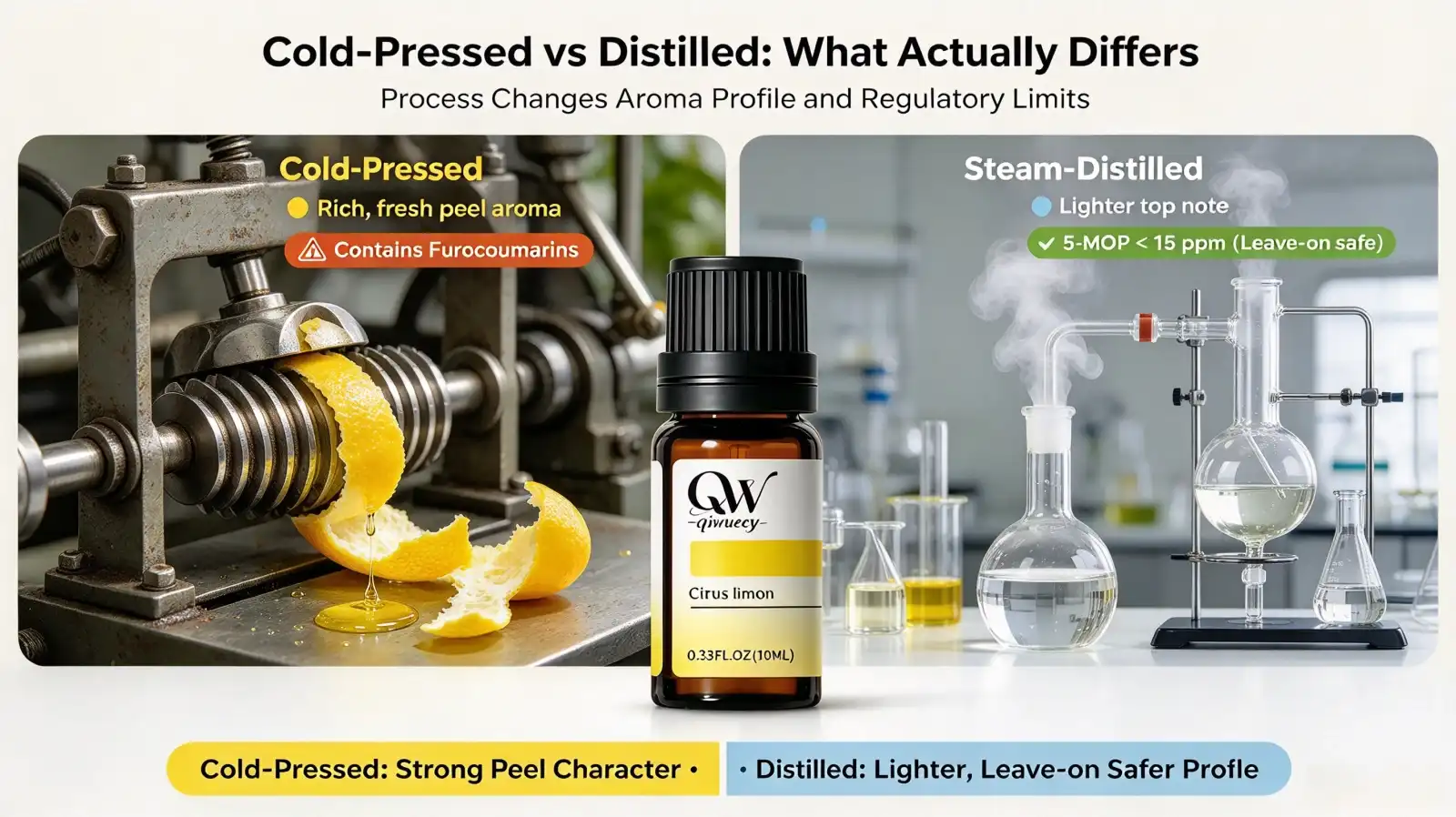
Cold-pressed citrus limon single essential oil would probably smell more like freshly zested peel, bright, with a somewhat oily flavor, and filled with the chemicals that live in the fruit’s rind. Steam-distilled versions sometimes seem cleaner and lighter, since the distilling process leaves behind some of the heavier peel-derived components that carry the more nuanced, rounder notes. Cold-pressed oil often has a peel-genuine scent that is favored for fragrance-forward applications like candles. Distilled oil may be a good match for formulas where a lighter top note that is less greasy would work well against the other blended ingredients. If fragrance character is important to the completed product, buyers should ask for a sample of both, since a written description seldom conveys the difference as well as smelling the two side by side.[5]
Photosensitivity and Furocoumarin Content
Cold-pressed citrus limon single essential oil preserves furocoumarin molecules that are largely eliminated in steam distillation, and this matters directly for skincare formulation. Specifically, per the IFRA 51st Amendment, leave-on products must not exceed 15 ppm (0.0015%) of 5-MOP (5-methoxypsoralen, a key furocoumarin). Distilled oil is, for the most part, the more practical alternative for leave-on skin products when photosensitivity is a concern. Cold-pressed oil is usually saved for rinse-off or non-skin uses such as cleaning products and candles. It is important to validate this difference on the COA rather than presuming based on the product name alone, since suppliers don’t often explicitly mention the extraction process or provide furocoumarin testing data on a simple listing.[2][3]
Shelf Life Variance by Extraction Method
Distilled citrus limon single essential oil usually lasts a little longer in storage than cold-pressed, mainly because cold pressing carries over more of the waxy and pigmented stuff that promotes oxidation. Neither extraction method produces essential oils as shelf-stable as woody or resinous oils; therefore, the same basic storage rules apply to both. For buyers looking at a longer inventory cycle, the extraction process should be a consideration in the decision on whether to restock – not an assumption that all citrus oil batches may be swapped interchangeably on the shelf.
Choosing the Right Extraction Method for Your Application
The proper decision is often a question of the ultimate use, rather than a question of preference for one approach over another. Skincare formulators tend to use distilled oil for photosensitivity reasons. Candle and home-fragrance businesses like to select cold-pressed for scent authenticity. Cleaning product formulators might use either, depending on cost and available supply. Asking a potential supplier what extraction process is used for a particular batch of citrus limon single essential oil, and asking for that data on the COA, prevents a mismatch that is only identified after a product is already in production.
| Factor | Cold-Pressed | Steam-Distilled |
|---|---|---|
| Aroma character | Closer to fresh peel, slightly oily | Lighter, cleaner top note |
| Photosensitizing compounds | Present (furocoumarins) | Largely removed |
| Typical shelf stability | Shorter | Somewhat longer |
| Common end use | Candles, cleaning, non-skin applications | Leave-on skincare, lighter fragrance work |
| Regulatory Limit (IFRA 51st) | Must not exceed 15 ppm of 5-MOP in leave-on products | Typically not detectable; easily meets limits |
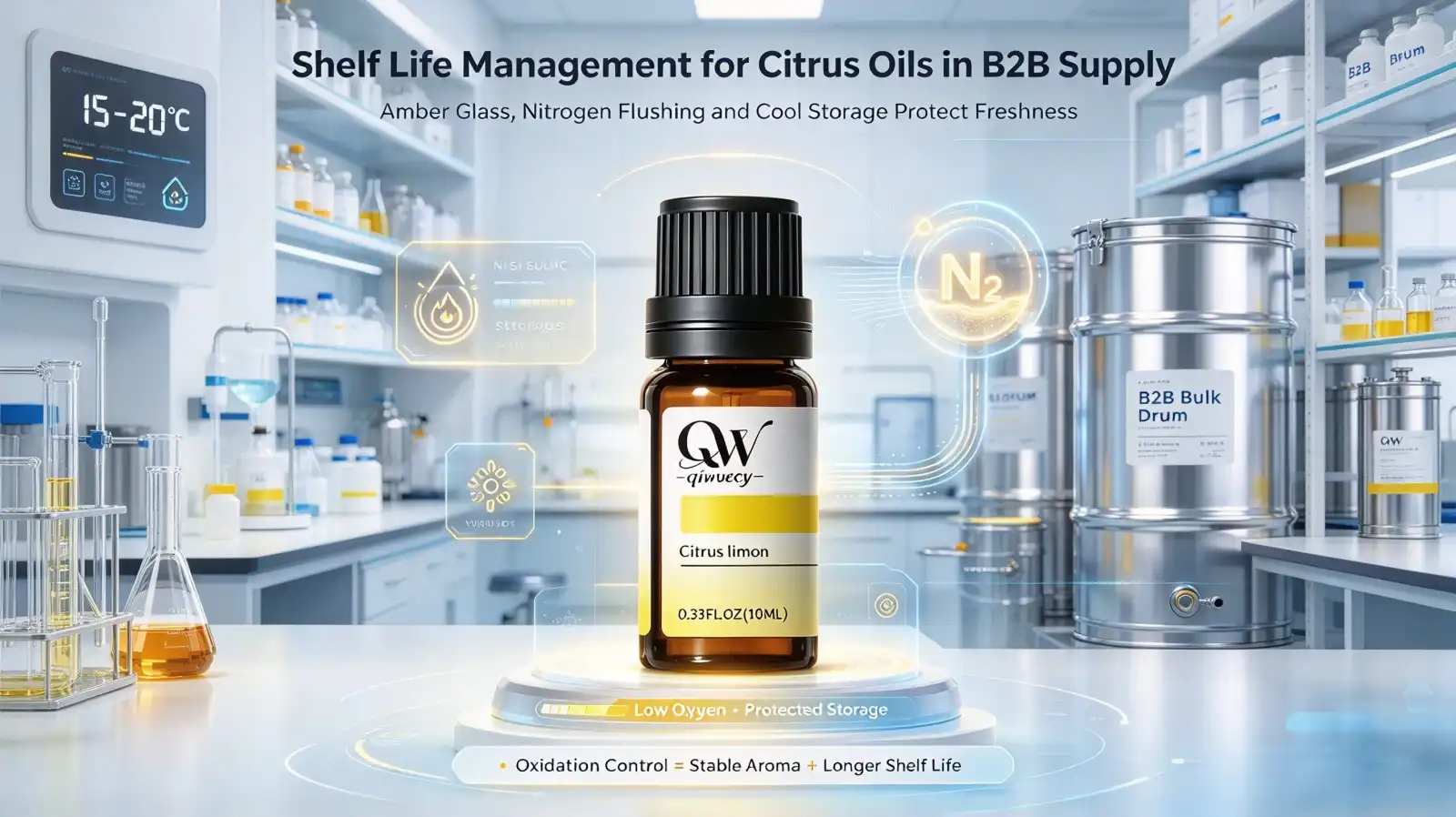
Shelf Life Management for Citrus Oils in B2B Supply
Why Citrus Oils Oxidize Faster Than Other Categories
Citrus limon single essential oil is mostly composed of monoterpenes, a kind of chemical that combines more easily with oxygen than the sesquiterpenes and other heavier molecules found in woody or flowery oils. This implies a bottle of citrus oil in a warm warehouse or exposed to light will change in smell and function far quicker than most other types of essential oil. For B2B purchasers, this is not a flaw to silently work around, but rather a planning input that should inform order frequency, storage conditions, and how far in advance stock is bought vis-a-vis production schedules.
Amber Glass and Nitrogen-Flush Packaging for Extended Shelf Life
The length of time that citrus limon single essential oil retains its intended character has been shown to be affected by the choice of packaging. Amber or other UV-blocking glass minimizes light-driven oxidation, and nitrogen-flushing a container before closing displaces the oxygen that would otherwise sit in the headspace and promote deterioration. Bulk drum purchasers may want to clarify if the provider nitrogen-flushes just smaller retail-style packaging, or also conventional shipping containers, since this feature is not always applied uniformly across all sizes of an order.[4]
Storage Conditions That Affect Stability
When citrus limon single essential oil arrives at a buyer's facility, the storage conditions are as critical as the package it arrived in. Generally, cool, dark storage away from temperature fluctuations keeps scent and composition longer than a corner in a warehouse where it may be exposed to sunshine or heat cycling throughout the day. Some buyers with higher inventory volumes underestimate the effect that a few degrees of temperature change over a season can have on the usable window of a citrus oil, so it is worth the modest added cost to include climate-controlled storage in a supply chain plan, especially for those orders that spend several months in inventory before use.
| Practice | Effect on Citrus Oil Stability |
|---|---|
| Amber or UV-blocking glass packaging | Reduces light-driven oxidation |
| Nitrogen-flushed headspace | Limits oxygen exposure inside sealed containers |
| Cool, temperature-stable storage | Slows overall degradation rate |
| Minimizing repeated container opening | Reduces cumulative oxygen exposure over time |
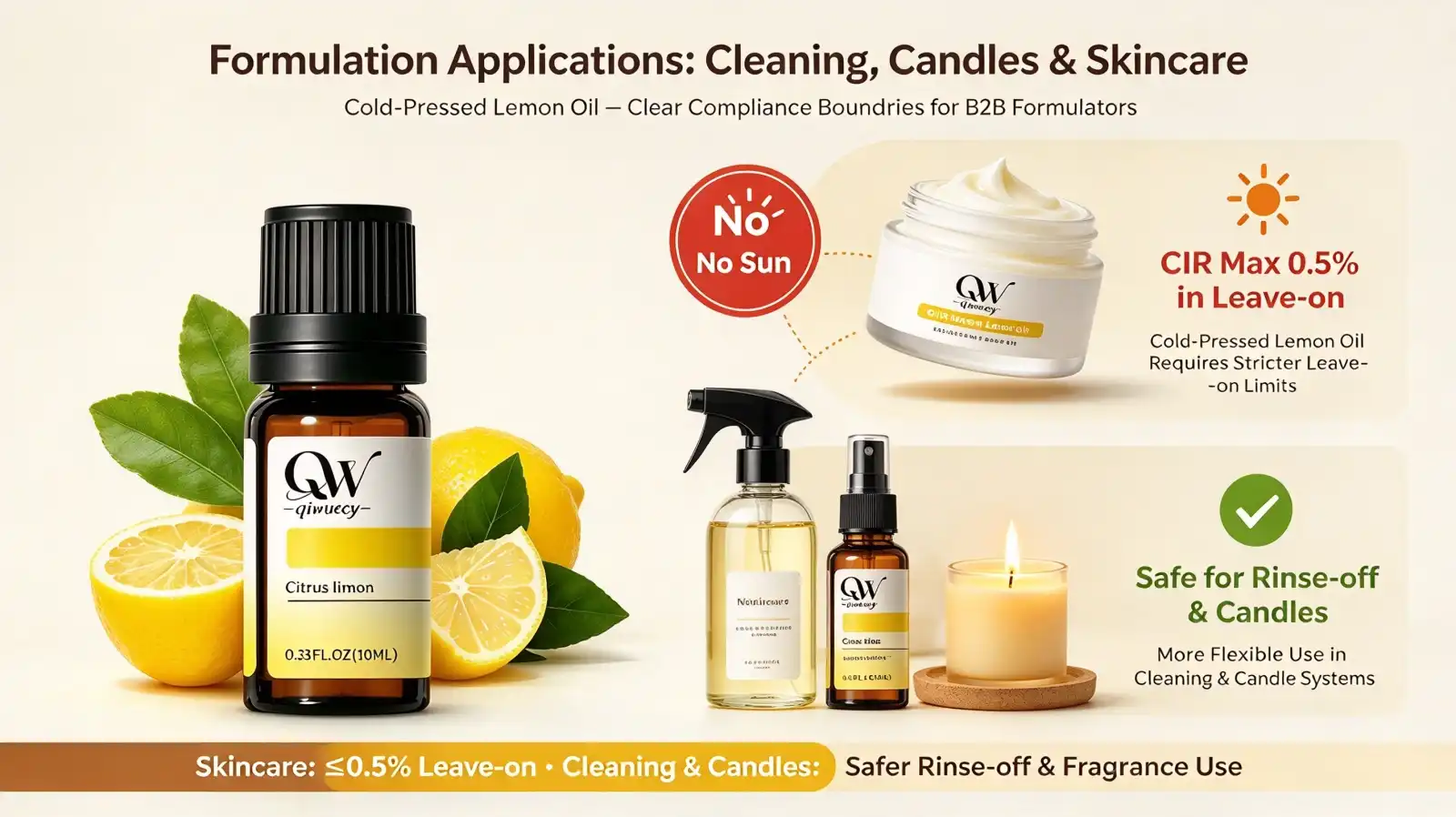
Formulation Applications: Cleaning, Candles & Skincare
Recommended Concentration in Household Cleaning Formulations
In household and light industrial cleaning products, citrus limon single essential oil is typically used at a moderate concentration relative to other formulation categories, since exposure and contact time differ from skin-contact products. Formulators generally test aroma intensity alongside surface compatibility during development rather than relying on a single fixed percentage. Because cleaning formulations vary widely by product type — sprays, wipes, concentrates — it's worth treating any concentration figure as a starting point and adjusting based on the finished product's actual use pattern.
Using Citrus Limon Single Essential Oil in Fragranced Candles
Candle formulators often favor cold-pressed citrus limon single essential oil for its closer resemblance to fresh peel aroma, though fragrance load and burn performance depend heavily on wax type and wick selection as much as the oil itself. Citrus top notes tend to be more volatile than base-note ingredients, so candle makers frequently pair citrus oil with longer-lasting woody or resinous components to extend how long the scent remains noticeable through a burn. Testing a small trial batch across a full burn cycle before committing to a larger production run is standard practice in this category.
Skincare Formulation Considerations and Photosensitivity
Skincare brands working with citrus limon single essential oil generally lean toward distilled rather than cold-pressed material, given the photosensitivity considerations tied to furocoumarin content discussed earlier. For cold-pressed material, the Cosmetic Ingredient Review (CIR) Expert Panel reports a maximum use concentration of 0.5% in leave-on products, strictly provided that the formulation is non-sensitizing, non-irritating, and meets the 15 ppm 5-MOP limit. Concentration guidance in leave-on products tends to sit toward the conservative end, with formulators adjusting based on the rest of the product's ingredient profile and intended use pattern. Buyers developing a new skincare line should confirm extraction method and request current formulation guidance from their chemist rather than relying on a fixed percentage carried over from an unrelated product category.
Blending Logic with Floral and Herbal Essential Oils
Citrus limon single Essential Oil Blends naturally with floral oils like lavender and geranium, which tend to round out its sharper top note, and with herbal oils like rosemary or basil for a more layered, less one-dimensional aroma profile. This kind of blending is common across cleaning products, candles, and fragrance work, where a pure citrus note can otherwise feel thin or short-lived. Buyers developing a blended product often request a small trial sample specifically to test how a given batch's aroma intensity holds up once diluted alongside other oils.
Sourcing Practicalities: Origin, Seasonality & MOQ
Comparing Origin Regions: Brazil, Italy, and the United States
Citrus limon single essential oils from various growing places tend to have modest variances in scent strength and composition, mostly due to climate, soil, and cultivar. Brazil and the US are important worldwide citrus-producing locations with large-scale production capability, whereas Italian-origin oil is typically linked with a more traditional, artisanal reputation in the fragrance business, often with a distinct availability pattern and price positioning. Buyers who are creating a formulation off a certain fragrance profile may ask for samples from many origins before choosing a major supply source. This is because, when oils are directly compared in a final recipe, geographical variance might be more apparent than anticipated.[1][6]
Seasonal Price and Availability Fluctuations
Due to the agricultural cycle of citrus limon single essential oil, the supply and market price tend to be seasonal rather than flat throughout the year. Buyers that make significant purchases just before or during a transition between harvests often have lengthier lead times or more limited accessible stock than at other times of the year. If you plan your buying around the general harvest calendar of your selected origin location – allowing for some flexibility – you will avoid the scramble that comes with purchasing at the worst moment in the cycle.
MOQ and Batch Size Planning for Citrus Oils
Citrus limon single essential oil order sizes are usually tiny trial volumes, frequently starting around 10ml for initial formulation testing and then into kilogram level and then bulk drum orders for complete manufacturing runs. Citrus is a seasonal commodity; therefore, some customers may purchase somewhat bigger reorders during the peak availability of the harvest rather than tiny increments year-round. That can help smooth out the fluctuations in lead times connected to the harvest calendar. Usually, this leads to better planning on both sides than reactive ordering as supply dwindles. Discussing a prediction of your output with a supplier in advance.

Conclusion
Three options define a seamless citrus oil supply chain: cold pressed vs. distilled citrus limon single essential oil, planning around its rapid oxidation rate, and scheduling orders against a seasonal harvest schedule. Buyers who vet extraction process, packaging methods and origin data up front tend to avoid the shelf-life shocks and reorder scrambles that catch younger sourcing teams off guard. If you are looking to construct a formulation around citrus this season, a realistic next step is to obtain a batch sample and current harvest-timing recommendations.
FAQ
Q: Should I choose cold-pressed or distilled citrus limon single essential oil for a skincare product?
A: Distilled oil is generally the more practical choice for leave-on skincare given photosensitivity considerations, though it's worth confirming the extraction method directly with your supplier rather than assuming from the listing.
Q: How much shorter is the shelf life of citrus oil compared to other essential oils?
A: Citrus oils generally oxidize faster than woody or floral categories due to their monoterpene content, so proper packaging and storage matter more for maintaining aroma and performance over time.
Q: Does packaging really make a difference for citrus essential oil shelf life?
A: Amber glass and nitrogen-flushed headspace both measurably slow oxidation, so it's worth asking whether a supplier applies these practices to bulk drum orders, not just smaller packaging.
Q: Why do citrus oil pricing and availability shift throughout the year?
A: Because it's tied to an agricultural harvest cycle, availability and lead time can tighten around harvest transitions, so planning purchase timing around your origin region's season helps avoid delays.
Source Citrus Limon Single Essential Oil with Qiwuecy
Qiwu Technology draws on more than a decade of atomization and citrus limon single essential oil manufacturing experience to support B2B buyers who need clear extraction-method documentation, stability-conscious packaging, and batch sizes that match real production needs. Whether you're comparing cold-pressed and distilled options or planning a seasonal order around harvest timing, our team can walk through sourcing details with you directly. Reach out to marketing@qiwuecy.com to request a sample or discuss your project's specification requirements — we're glad to help you plan your citrus sourcing with confidence.
References
1. International Organization for Standardization. ISO 3140 — Oil of lemon (Citrus limon (L.) Burm. f.).
2. International Fragrance Association (IFRA). IFRA Standards addressing furocoumarin and phototoxicity considerations in citrus oils.
3. Cosmetic Ingredient Review (CIR) Expert Panel. Safety assessment publications on Citrus limon peel oil.
4. Journal of Essential Oil Research. Published studies on citrus oil composition and oxidative stability.
5. Flavour and Fragrance Journal. Research literature on cold-pressed versus distilled citrus essential oil profiles.
6. Food and Agriculture Organization of the United Nations (FAO). Citrus production and seasonal harvest reporting.
Online Message